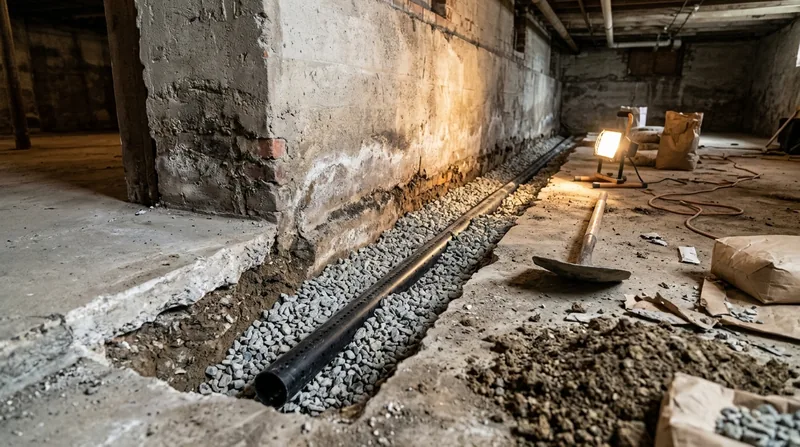


Muncie sits on the flat Tipton Till Plain where the White River bends through Delaware County, and that geography decides how basements here handle water. Dense glacial clay soil drains slowly, so the water table stays high through spring, and every long rain pushes hydrostatic pressure against limestone, brick, and block foundations. If you have water in the basement after a storm, an Interior Drain Tile System in Muncie intercepts it at the footing and moves it out before it ever reaches the slab. We install interior perimeter drain beneath the slab edge, tie it to a sump basin, and pump the water outside. It is the proven year-round answer for homes on this flat till, from the 1880s gas-boom Victorians in Old West End to the poured-concrete basements in Yorktown. Start with a free basement inspection so we can confirm what your foundation is actually doing.
Why Interior Drain Tile Matters on Muncie's Slow-Draining Glacial Clay
Most wet basements in Muncie are not a crack problem, they are a water-table problem. The city's heavy spring rain, summer thunderstorms, and hard freeze-thaw cycles push groundwater into the footing drain, and on 1900s-1940s bungalows in Riverside-Normal City near Ball State that original weeping tile is often crushed or clogged with clay. When it fails, water rises under the slab and finds the path of least resistance.
- Hydrostatic pressure forces water through limestone mortar joints and block cores, not just visible cracks.
- Old footing drains in gas-boom-era homes silt up and stop carrying water to the storm line.
- Low ground along the White River and Buck Creek floods with spring crests and saturates the soil for weeks.
- Downspouts that dump next to the foundation recharge the same clay that is already holding water.
An interior perimeter drain relieves that pressure at the footing instead of fighting it at the wall surface.
Key info: A 1920s foursquare in Riverside-Normal City with a wet block wall every March usually has a failed footing drain, not a failed wall. We have seen the same pattern in Westwood and Thomas Park ranches built on block basements in the 1950s and 1960s.
Indiana homeowners can verify contractor licensing and local permit requirements through the Indiana Professional Licensing Agency, and Muncie and Delaware County building departments confirm what applies to your address.
How We Install an Interior Drain Tile System in a Muncie Basement
We work from the inside, so we do not excavate your yard, disturb landscaping, or dig up a mature river sycamore in the setback. The sequence is the same whether we are in a 1910 Italianate on a limestone foundation or a 2005 poured-wall home northwest of the city. Every job starts with a moisture read of the wall and slab so we know where the water is entering.
- We break and remove a 12 to 16 inch channel of slab along the perimeter wall.
- We dig down to the footing and clean out the old drain tile or clay that is blocking flow.
- We set perforated pipe in washed gravel with a filter fabric sock to keep glacial fines out.
- We core and set the sump basin at the low point and connect the perimeter loop to it.
- We install the sump pump, check valve, and discharge line, then pour new concrete over the channel.
The result is a continuous path that carries water to the sump basin instead of letting it sit against the wall.
Key info: On a 1960s split-level in Yorktown, we found the original weeping tile packed solid with clay and gravel. Clearing it and tying in a new interior loop took one day and stopped the spring seepage that had been soaking the baseboard for years.
If your existing drain is crushed rather than just clogged, we handle that under drain tile repair and replacement, and we size the pump and basin to the volume your footing actually moves.
Interior Drain Tile Approaches We Use in Delaware County
Not every basement needs the same configuration. The right layout depends on the foundation type, the water volume, and whether the sump can discharge by gravity or needs a pump. We choose the approach after the inspection, not before.
| Approach | Description | Best for |
|---|---|---|
| Full interior perimeter drain | Continuous loop at the footing tied to one sump basin | Whole-basement seepage on block or limestone walls |
| Partial perimeter drain | Drain along the wet wall only, tied to an existing sump | One-sided seepage where the rest of the wall stays dry |
| Drain plus dimple board | Drain at footing with a membrane guiding wall water down | Efflorescence and wall seepage above the cove joint |
| Drain with battery backup | Interior loop with a backup pump on standby power | Homes that lose power during spring storms |
We match the layout to the water volume we measure, not to a standard package.
Interior Drain Tile System Cost in Muncie: What to Expect
Interior drain tile pricing starts at From $50/linear ft for the drain run itself, and most Muncie basements land in a range that reflects perimeter length, foundation type, and sump requirements. A 1,000 square foot basement with a simple perimeter loop is a very different job from a limestone Victorian where we have to cut carefully and rebuild the slab edge. We quote the full scope in writing so there are no surprises after the concrete is poured.
- Perimeter length drives the base number, since the drain is priced by the linear foot.
- Foundation material matters: limestone and brick need slower, more careful cutting than poured concrete.
- Sump basin, pump, check valve, and discharge line are separate line items you should see spelled out.
- Access and slab thickness affect labor, especially in older homes with finished basement floors.
Get two or three written estimates and compare scope, not just the bottom line. Our full pricing overview breaks down what each line item covers.
Interior Drain Tile System Near Me: How to Vet a Muncie Waterproofing Contractor
Waterproofing is a specialty, and it is not the same trade as general foundation repair or plumbing. Ask direct questions before you sign anything. A contractor who cannot explain why hydrostatic pressure is the cause, and why an interior system beats exterior excavation in your case, is guessing.
- Confirm the company carries liability insurance and workers' compensation, and ask for a certificate.
- Get at least two written estimates that itemize the drain, sump, and discharge separately.
- Ask for local references from Muncie, Yorktown, or Selma jobs you can call.
- Ask who pulls the permit if the work alters drainage or the sump discharge connection.
We are a Basement Health Association member and we put our scope in writing. Reach out through our contact page to schedule a walkthrough and get a straight answer on what your basement needs.
Interior Drain Tile System in Muncie: Pricing Guide
| Service | Price | Details |
|---|---|---|
| Full interior perimeter drain | Starting at $50/linear ft | Includes channel cut, perforated pipe, gravel, and filter fabric; perimeter length drives the total. |
| Partial perimeter drain | Starting at $55/linear ft | Drain along the wet wall only, tied into an existing sump; access and slab thickness move the rate. |
| Drain with new sump basin and pump | On estimate | Adds basin coring, pump, check valve, and discharge line; pump size and discharge routing set the number. |
| Limestone or brick foundation work | On estimate | Older gas-boom-era walls need slower cutting and slab-edge rebuild, so we price after an on-site look. |
| Estimate and inspection | Free | Response within 24 hours at (765) 540-8202, no obligation to book the work. |
Indicative pricing, the exact cost depends on square footage, finish, and site access. Free personalized estimate within 24h at (765) 540-8202.


